
Units 24 and 25: The Solar System, the Stars, and the Universe
- Colum
- Jan 5, 2024
- 3 min read
Updated: Jan 25, 2024

Finally, my favourite part. It's a shame that theres only 2 units on space.
You should all know the planets in the solar system and their order. They are kept together due to the gravitational attraction to the sun.
In fact, the solar system formed because of gravity. This is called the accretion model. Clouds of interstellar dust and gas (a nebula) were pulled together by gravitational attraction, and formed a sphere, and later a disk. The hottest, densest part became the sun, the heavy elements formed rocky planets, and light elements formed gaseous planets far away from the sun.

As the distance of the sun increases, the gravitational field strength decreases, and the orbit speed of any orbiting object decreases.
Planets follow a slightly elliptical orbit.
The speed of an object in orbit can be calculated using v =(2πr)/t , basically calculating the circumference of the orbit and dividing it by the orbit duration.

the distance between the sun and the earth is one AU (astronomical unit). It takes light 8 minutes to travel 1 AU.
The earth spins on its axis every 24 hours, causing day and night.
The earth is tilted, causing the seasons as the earth orbits the sun every 365 days.

The moon orbits the earth every 27.5 days, causing the phases of the moon.

However, not all orbits are on the same plane. The orbits of comets are eccentric.

This is because while entering the solar system, the comet is affected by the gravitational fields of many large planets.

While in orbit, when the planet is the closet to the sun, (point A), its velocity is the greatest, and therefore the kinetic energy is the greatest. At the furthest point of the orbit, (point B), the planet has the greatest gravitational potential energy, but the lowest velocity.
Now let's learn about stars. Our sun is an average star. (G class main sequence yellow dwarf)

Stars begin as protostars from the collapse of interstellar gas clouds and then start using hydrogen as their fuel.
A stable star uses hydrogen as fuel and the outward force of radiation pressure due to its high temperature balances the inward force of gravity. Average stars (less than 8 times the mass of the sun) turn into red giants when they run out of hydrogen for fusion. and when they run out of helium, they form a planetary nebula and shrink into white dwarfs.
High mass stars will explode into a supernova and collapses into a neutron star of a black hole if it is truly massive. During supernova, elements heavier than iron are created and sent into interstellar medium, as nebulae that form the raw material for new stars and solar systems.
Stars fuse hydrogen and helium in their cores.
They emit many electromagnetic waves, including infrared, visible, and ultraviolet.
A light year is the distance light travels in a year. speed of light: 3*10^8
Red shift is the increase in wavelength of electromagnetic radiation.

Light from distant galaxies are redshifted, suggesting that they are moving away from us. This proves that the universe is expanding.
The hubble equation describes how the speed of galaxies is proportional to their distance from us.
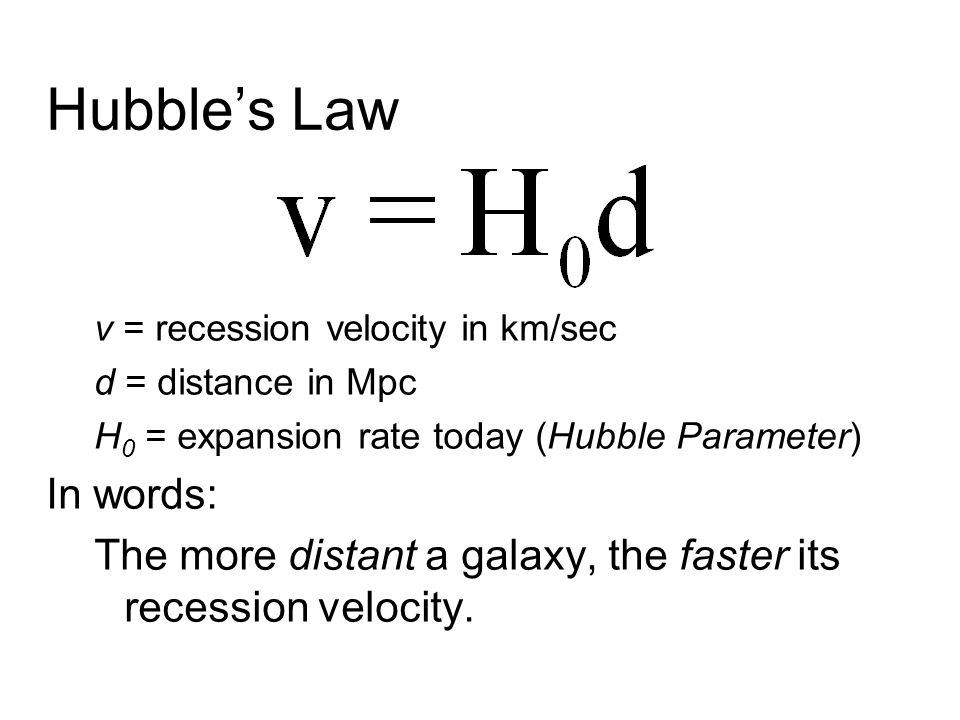
(Mpc is megaparsec)
The cosmic microwave background is the electromagnetic radiation from the early universe that has redshifted and its wavelength stretched into the microwave region of the spectrum.
That's it for now. It is important to note that I have omitted certain details to make this as concise and helpful as possible. If there is something I have not covered here, please leave a comment on the forums.


Comments